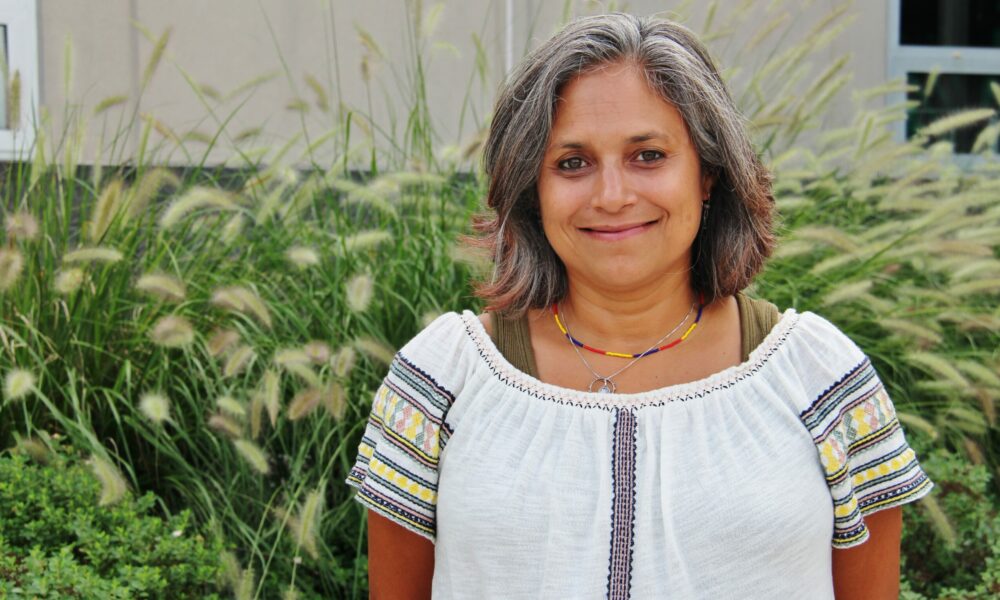
Today we’d like to introduce you to Stephanie Flores-Koulish.
Hi Stephanie, it’s an honor to have you on the platform. Thanks for taking the time to share your story with us – to start maybe you can share some of your backstory with our readers?
Piloting and overseeing a program dedicated to teaching teachers about social justice teaching practices in many ways is a wonderful dedication to my life, which has long been committed to serving and uplifting those who are marginalized vis-a-vis education. The Curriculum andInstruction for SocialJusticeMasters of Arts program at Loyola University Maryland is not another program that’s riding a woke wave post-George Floyd’s murder, but instead, it was an intentional name change in 2018 to reflect the ideas and concepts of the program that had long been in existence thanks to Loyola’s Jesuit commitment to social justice.
I feel humbled that I have this wonderful opportunity to work with Baltimore and Maryland educators who have a passion for improving their practice and the field of education to be more intentional in the ways that it seeks to uplift students at the margins and inform those who are privileged about how to discern, and in turn, flatten and share opportunities they received as a result of their birth. The teachers I serve primarily teach in Baltimore City public schools, Baltimore County stretching up to the Pennsylvania line, and in the Catholic and independent schools in and around Baltimore.
In addition to my primary teaching and administrative duties overseeing this program at Loyola, I also have the honor and pleasure of engaging in research and service in schools and organizations related to my interests in critical media literacy education and social justice education. I have presented professional development at many different schools and school districts, which have included related presentations, teacher mentoring, and curricular equity audit work. In addition, I had the fortune of serving on the board and being the board chair for the dual language Archdioceseof Baltimore school, Archbishop Borders in Highlandtown for a few years to witness their growth and development. I currently serve on the national board of the National Association for Media Literacy Education (NAMLE).
I chaired their 2021 conference which was themed, Media Literacy and Social Justice, and I’m co-chairing the summer 2022 conference.
I feel so fortunate that I have been able to bring so much of myself and my creative passions to my work and vocation here at Loyola University Maryland and on behalf of Maryland teachers and their students. Upon my arrival to Loyola in 2002, I was sharing with anyone who would listen about the importance of teaching students about the media and popular culture and its influence on our identities and understandings of our world. Fast-forward, and not only has the need for media literacy become increasingly imperative, we have one of the few long-standing graduate classes in media literacy education for practicing teachers in the United States where teachers learn how to teach their students how to “access, analyze, evaluate, and communicate messages in a variety of forms” as NAMLE suggests. Not only that, but given that the class is situated now within a program dedicated to social justice, teachers walk away from our program with the knowledge and skills to intersperse innovative teaching practices using materials that come from our world today, thus equipping students to be discerning citizens and better critical thinkers.
While my story here is one of being a professional, a college professor, probably, more importantly, I am also a wife to Robert, a professor at The University of Maryland College Park,and a proud mother of three children who have mostly been raised in Baltimore City. Two are now off to colleges at NYU and the University of Maryland, College Park, and another is a high school student at Calvert Hall College. I am proud to say that they are each ethical and empathic human beings who I know will make a positive impact on their own worlds as they become adults.
Can you talk to us a bit about the challenges and lessons you’ve learned along the way. Looking back would you say it’s been easy or smooth in retrospect?
In many ways, my story is one of a turtle in a race against the hare. I like to tell my students the story of how I, as a very quiet elementary student in Prince Georges County was asked to take a test that I later found out was to determine whether I would qualify for a talented and gifted program. I recall the test consisting of strange questions involving short-term memory and the manipulation of information. And my greatest memory is of not passing the test, and afterwards feeling as though I was destined to be an average student, since I didn’t qualify as “talented and gifted.” And thus, that was the continuance of my K-12 career, one of just passing and being average, while legitimately struggling with mathematics throughout that time.
But it probably helps to go back even further because I started life differently from most as a Colombian baby living at St. Ann’s Infant and Maternity Home in Washington, D.C. before getting adopted by my working-class parents, a White mother and a Mexican- American father, and joining my German/American adopted brotherat our home inside the DC beltway. We were our own multicultural enclave without even realizing or honoring it. Instead, I felt often like an outcast as one of the few, if only, brown girls among working class White and African American kids at my schools. No one knew how to classify me, and I was often asked “What are you?” Without the guidance from home, I stumbled to gain the confidence to name who I was, which perhaps explains why I am sensitive to people who feel different. I was drawn to my research field of media literacy education for the ways that I knew that the media helped me to skew my identity growing up, and I knew that others should have the capability to question the ways thatthe mediainforms our identities regardless of whether we have families that look like us.
At the end of my Catholic all-girls high school experience, without high GPAor SAT scores, or solid college guidance, but with a strong wanderlust, I joined the Air Force and became a Russian linguist, serving in West Berlin, Germany, while the Berlin Wall stood and later fell while I still lived there as a civilian. Fortunately, I knew by this point in time that I wanted to be a teacher and work with children. Time and dedication finally paid off, and I was a teacher of record with a master’s degree in special education 11 years after graduating high school. My first year as a teacher wasn’t the typical experience. I taught English at a private school in Cali, Colombia, thus doing my best to better understand myself, while having an adventure and honing my classroom skills. Upon returning to the U.S., I knew I would ultimately pursue more education after having an excellent mentor in my master’s program who believed in me and my intelligence unlike anyone had before. After two more years in the classroom, I started Boston College’s Ph.D. program in Curriculum and Instruction. I approached this program like any other job I had– worked hard, graduated in four years, and was hired by Loyola College as an assistant professor in 2002 where I’ve been ever since.
So, I would say that my obstacles and challenges early on were many, yet those were obstacles and challenges that continue to feed me and the evolution of my work here at Loyola University Maryland in the Curriculum and Instruction for Social Justice Master’s program. My goal ultimately is to help children to not feel so alone or so that other children may not be subjected to the determinations of one test on one day that some people believe really means something. I seek to inspire teachers to truly get to know their students, their strengths, talents, and their potential. I owe my life to those who are outcasts or marginalized, and I will continue to be a voice for the voiceless in the work that I do at Loyola and in the wider community. Studying and then working at a Jesuit institution has provided this turtle with an outlet to pursue the work I love while aligning with the mission of my university. I truly feel as though I’ve won the race.