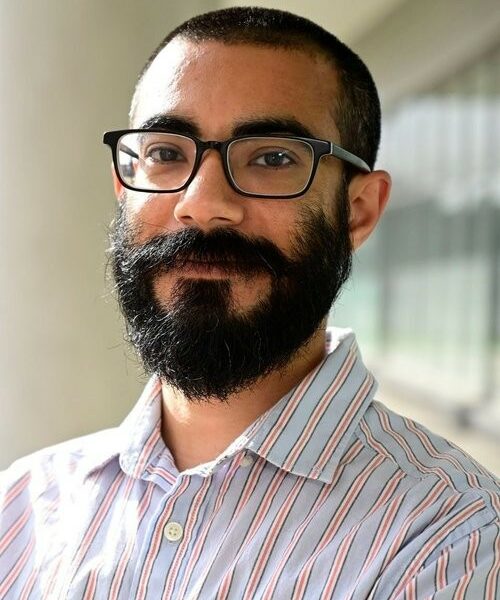
Today we’d like to introduce you to Harold Morales.
Hi Harold, so excited to have you with us today. What can you tell us about your story?
My family is from Central America. My grandparents were farmers and preachers. My parents where accountants before a devastating earthquake prompted their migration to Los Angeles. My dad worked as a mechanic, taught theology on Sundays, and loved his fruit trees. My mom taught me and my three siblings to talk while walking. We learned to listen to and tell stories while moving, just like her mother taught her. I move and change to process and adapt, to seek out and achieve well-being, even if only for a moment.
I met my partner 17 years ago at my grandparents’ church. We’ve gone through profound changes together and remain madly in love and committed to one another as we raise two amazing children in the city of Baltimore. They shape my storied wanderings and dream work, along with a growing chosen family of friends and collaborators.
My latest dreaming grows from my roots in Central America, my Ph.D. work, and my teaching in the Department of Philosophy and Religious Studies at Morgan State University on the in-between. I look for places of magic where the land and those who dwell on it form relationships of reciprocity among each other. Where words and lived experiences help bring each other into existence. With generous support from numerous collaborators, including Morgan State and the Henry Luce Foundation (HLF), I started the Center for Religion and Cities (CRC) in 2018. The CRC is a collective of researchers, students, and community partners who grow and nurture innovative and collaborative solutions for improving the quality of life in our cities. During the early months of the pandemic, and with additional support from the HLF’s rapid response grants, we financially supported and filmed documentaries of our partners providing direct aid in the form of food, housing, and PPE assistance. A good friend and collaborator, Dr. Samia Rab-Kircner, helped write and manage one of these grants for the Plantation Park Heights Urban Farm in Baltimore. Farmer Chippy and Farmer Tiara commissioned designs from Morgan students for an outdoor demonstration kitchen for ventilated food processing and distribution. I fell in love with the place and its reciprocity with residents and farmers in Park Heights on a once vacant and abandoned lot.
At the farm, we plant, grow, harvest, and distribute food for physical and spiritual well-being. Every step is a pilgrimage from which food and community grow. It is a meaningful moment of healing and also part of a longer, holistic, and life-giving way of being in the world. Where I am today is constantly changing, I’m on the move, usually on a long wandering in Baltimore, DC, or Philly. But if you’d like to stop by for a chat and ask about the work I’m doing today, I’m either teaching at Morgan or farming and sketching in my notebook with my good friends in Park Heights on Thursdays when we pass out free boxes of food and cultivate good vibes.
Can you talk to us a bit about the challenges and lessons you’ve learned along the way? Looking back would you say it’s been easy or smooth in retrospect?
I grew up with abbreviated seasons in Los Angeles so living on the east coast has offered a new appreciation of life’s cycles. As people, we move through times of scarcity, dread, and sorrow to times of abundance, dreaming, and joy. The struggles can be in the granular, like when we fill out digital forms while juggling a chaotically growing to-do list. Or when we misplace a farm tool after something else needed your attention, leaving you frustrated and unable to complete the work. The struggles can also be in the devastating collapse of meaningful work, like lost crops or abandoned research projects. But the most devastating struggles regard spirit, like when we lose another loved one and it feels like there’s nothing left to fuel our work when our compass no longer works, and despair and hopelessness loom large.
I often struggle most with changes that threaten our ability to dream. Change is a part of life, we can anticipate and move with it as we do with the seasons, and all the better when with a beloved community that supports one another. I am grateful to those who have helped sustain me during times of despair and I hope to be there for them in their own wintery times of scarcity. And def hope to be there for the harvest as well lol!
Alright, so let’s switch gears a bit and talk business. What should we know about your work?
I work to bridge gaps, to translate, and to connect. I do this primarily through reading, writing, learning, and teaching. My undergraduate degree is in Philosophy and my master’s and Ph.D. degrees are in Religious Studies. My research and teaching focuses on the intersections between race and religion and between lived and mediated experience. I use these critical lenses to engage Latinx religions in general and Latino Muslim groups in particular. I’ve published numerous articles and book chapters on this work as well as a book in 2018 with Oxford University Press titled Latino and Muslim in America: Race, Religion, and the Making of a New Minority. I’ve also been awarded and managed nearly $2.5 million dollars of research funding from the Henry Luce Foundation to work on public scholarship initiatives and community empowerment as founder and executive director of the Center for Religion and Cities at Morgan State University where I am an Associate Professor in the Department of Philosophy and Religious Studies.
One of the initiatives I’m most proud of is Betting on Hope (https://bettingonhope.org) in which nearly 100 people collaborated to distribute, document, reflect on, and tell the story of the spirit that animated direct aid efforts during the early part of the pandemic. I learned a lot about the potential of collaboratively and iteratively grown processes which we’ve been able to apply to our more recent and thriving work on the Good Life Project (https://www.religionandcities.org/goodlife) and Lifeways of Hope (https://www.religionandcities.org/lifeways) initiatives which seek to support community-led work through deep listening practices.
What has been the most important lesson you’ve learned along your journey?
To listen for and help grow collective dreaming, collaborative work, and communal well-being!
Contact Info: