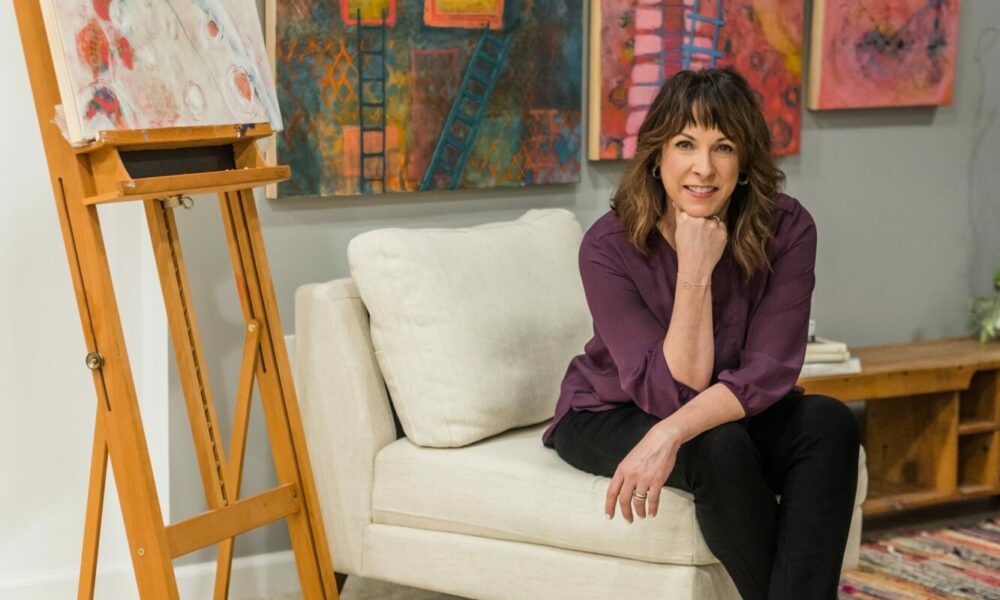
Today we’d like to introduce you to Terri Yacovelli.
Hi Terri, we’re thrilled to have a chance to learn your story today. So, before we get into specifics, maybe you can briefly walk us through how you got to where you are today.
I am an artist who lives and works in York, Pennsylvania. I spent many years as a studio art teacher and adjunct professor of art. Teaching to different types of students, from young people to adults at the college level, has strongly reinforced my belief that art is for everyone. We are born with the inherent need to create, but somehow, life discourages us to fully express ourselves. I always want to help others use their art to find their voice. Making art is not just about making something that looks great; it’s about the challenge and enjoyment of creating and having pride in resolving a problem. A project gives us a purpose.
Now I am a full-time artist. The medium I use is encaustic. Encaustic paint is heated beeswax with pigment added. Each layer is fused to the previous with a blow torch. So, I guess you could say that I paint with fire.
I’m sure you wouldn’t say it’s been obstacle free, but so far would you say the journey has been a fairly smooth road?
Most of my adult life I was a full-time educator, wife, and mother, so it has not been easy to make time for my art, but I have always made it a priority. I made the decision that even if that meant my studio time was after everyone was asleep, then that’s how it would be. I didn’t just want to do it; I had to do it. Being an artist and creating is an essential part of who I am. Intuitive painting is a way to explore and uncover aspects of our inner self; it’s a spiritual practice as well as a way to create a body of work. As women and caregivers, we are often made to feel that doing things for ourselves is ‘selfish’. Making my art an essential part of my life has shown my children how important it is to have something in your life that you are passionate about.
An added bonus is that they have an appreciation for the arts and for supporting art in their community since they went to museums and gallery openings with me from the time they were very little.
Alright, so let’s switch gears a bit and talk business. What should we know about your work?
Encaustic wax is kept warm on a hotplate, so the wax is very fluid. It can be poured, stamped, or carved. The tools used in encaustic are often the same you use for hand building with clay. The earthy smell of the beeswax and using the wax to create interesting surface texture had me hooked right away. I think having previous painting and sculpture experience helped me get a handle on the medium. For example, when I painted with oils, I liked to build up a strong underpainting first, then glaze more layers on top. This is a good way to work with encaustic. Layering opaque and transparent encaustic colors creates paintings that suggest luminosity, depth, and dimension. You do this by adjusting how much beeswax medium is added to the color. You can scrape through to expose previous layers and color. There is heightened visual interest since marks can be hidden and revealed.
Experimentation in art is important; you have to be willing to make mistakes in order to move forward. I made the conscious choice not to take a bunch of encaustic classes at first. Because I have been teaching studio art for a long time, I was excited about using something I didn’t know much about. I was the student for a change and wanted to allow myself the joy of discovery. This gave me a playfulness with the materials, and I couldn’t wait to try different things with encaustic. I searched for weird textures to imprint into the surface. I embedded string, coffee, couscous, glass, and leaves into the wax. All of this experimenting created some epic failures, but I learned what to do and what not to do. Since starting, I have completed a lot of research on my own and have worked with other encaustic artists to learn new techniques to expand my skills. It has been an investment in both time and materials.
The encaustic process can be frustrating; it often has a will of its own. You can’t fight with it. When it’s hot out, or if you over-fuse with the blowtorch, the wax takes forever to set. You can’t move on with the piece. If it’s too cold, the wax sets up too fast. Sometimes your plan works out, and other times you have to give in to the medium and the moment and just let go. That was hard for me as a structured, type “A” person, to let the painting lead the way. The lessons we learn during our studio practice can be applied to physical, mental, and emotional aspects of our everyday lives. It’s not unlike having a yoga practice; everything we learn in yoga class can be translated off your mat and into the real world. The creative process is the same way.
If we knew you growing up, how would we have described you?
I was a total tomboy growing up. I had two brothers, and there were mostly boys in my neighborhood, so I was outside digging in the dirt, climbing trees, and playing tackle football. If I wasn’t outside, I was inside coloring and drawing. My mother has little doodles of all these exotic animals I drew and labeled. My father does woodworking, so I loved to make sculptures by gluing scraps of wood together. I was always making something!
Contact Info:
- Website: https://www.terriyacovelli.com
- Instagram: https://www.instagram.com/tyacovelli/
- Linkedin: https://www.linkedin.com/in/terri-y-969685181/


Image Credits
@erinelainephoto