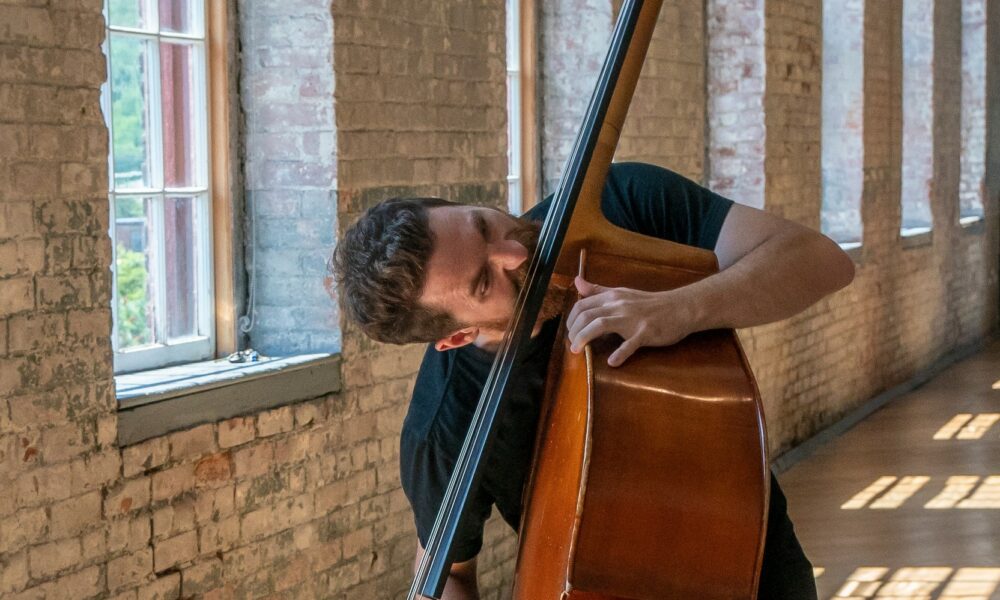
Today we’d like to introduce you to Will Yager.
Hi Will, so excited to have you on the platform. So before we get into questions about your work life, maybe you can bring our readers up to speed on your story and how you got to where you are today.
My first musical experience was in my school band (I first played the trumpet), but I took up the bass guitar when I was about 15. I had friends that played guitar and drums, so someone needed to step up. I was immediately in love with it and even carried around a binder full of Led Zeppelin and Metallica tabs to “study” before I’d finished saving up enough money to buy my first bass. I found my way to musicians like Jaco Pastorius and Victor Wooten, and through them discovered jazz. Like so many other bassists, Jaco’s recording of Donna Lee blew my young mind. I got the seminal Miles record “Kind of Blue” for Christmas from my sister the following year, which was pretty much it for me. A little later, though, I decided I wanted to play the double bass. I was listening to jazz obsessively, and after listening to the classic Bill Evans Trio (with Scott LaFaro and Paul Motian) and Chick Corea’s Akoustic Band, I knew the double bass was it. I have a core memory of sneaking back to the living room after my folks had gone to bed to watch a concert recording on Youtube of Chick’s trio with John Patitucci and Vinnie Colaiuta over and over again until the sun came up. However, it took the rest of high school to save enough money for a bass, and I finally got one shortly before graduating.
While jazz was still my passion, I happily began studying classical technique & repertoire in college to get a basic foundation on the instrument. Since I was late to the double bass, my college experience was learning the instrument. My interest in classical music grew with my time in it, and my musical interests were split 50/50 by the time I finished college. I went straight into a Master’s program to keep getting it together, and by the time I graduated, I was playing enough gigs to scrape by. I spent the next few years playing in orchestras, leading my jazz trio, and teaching at a few colleges. I was happy with the stuff I had career-wise but started to feel creatively unsatisfied. I attended a local summer music festival (the Nief-Norf Summer Festival) and discovered a new passion for contemporary chamber music. I decided to return to school to focus on contemporary performance/repertoire, and I moved to Iowa to attend the University of Iowa on a fellowship. I spent my four years there, immersing myself in contemporary and experimental music, and traveled every summer to participate in various festivals focused on contemporary music. Two of the main avenues of my work, my chamber duo LIGAMENT, and improvising trio Wombat, were formed during my time in Iowa, too. After completing my doctoral work, I decided to move here to Baltimore! The arts scene here is wonderful, and I’m very grateful to have been welcomed into the music community so quickly.
Would it have been a smooth road, and what are some of the biggest challenges you’ve faced along the way?
I think artists in this country need a smoother road available to them! Especially those of us doing work that could be more commercial. I was fortunate to make a living playing the bass during my chapter in Tennessee, but that required a more trade-oriented mindset and playing any music so that I could say “yes” no matter what the gig was. There is nothing wrong with this, and I’m grateful that my early teachers equipped me with a broad skill set. But that isn’t exactly art-making (most of the time), and it almost resulted in creative burnout for me. After trying to focus on the music I want to make, things have been even more challenging. There are also so many hidden costs in trying to live as an artist. Every discipline has its version of this, but “pay to play” is sadly rampant. Much of what has happened for me is because of the wonderful people I know all over the country, but I had to spend thousands of dollars on summer festivals to meet them. Things like this, and the costs of instruments, make music an impossibility for so many (I still play the first double bass I ever purchased). All of that said, I am grateful to have a supportive family and many dear friends that have helped me in immeasurable ways.
Thanks – so, what else should our readers know about your work and what you’re currently focused on?
While I was initially trained in jazz and traditional Western classical music, my primary concerns for the last several years have been contemporary, experimental, and improvised music(s). Some of these descriptors fall short and often mean little to people not already in this world. For example, to folks familiar with the classical music world, the term “new music” more or fewer works, but to people outside of the scene, it understandably might not mean much. Another label sometimes used is “contemporary classical,” but that’s always been unsatisfying as it is a contradiction. I generally find myself saying, “music that is composed, but now or recently.” It can mean many things, but I also think of this music as having some relationship to notation. My other zone of interest is improvised music. Since jazz was my first love, I’ve improvised in some capacity since I started playing music. These days I mainly improvise in freer and more experimental contexts. My practice is equal parts generative (improvisation) and interpretative (notated music).
These are broad categorizations, and most of the best stuff needs to be more neatly labeled. Some of my most satisfying collaborations with composers are those that take advantage of my abilities and language as an improviser in the context of a formalized piece. That said, most of my work is as a soloist, my duo LIGAMENT, and my trio Wombat. LIGAMENT is my amazing friend Anika Kildegaard (soprano) and me. Being a soprano-double bass duo, we play contemporary music exclusively. We’ve done a lot of commissioning for the ensemble and made some of our own work too. My trio Wombat, with Justin Comer (saxophone) and Carlos Cotallo Solares (guitar/electronics), focuses on free improvisation. I’m very proud of both groups and believe in what we’re doing. I also perform quite a bit as a soloist, giving recitals of music I’ve commissioned and solo performances that are entirely improvised.
The thing that might set me apart is my willingness to try pretty much anything. I try never to say “no” when working with composers/other collaborators without at least giving the idea a shot. I also generally bring a lot of energy to the work and support new pieces by trying to concertize as much as possible.
Contact Info:
- Website: https://willyager.com/
- Instagram: https://www.instagram.com/yagerwill/
- Facebook: https://www.facebook.com/will.yager.1/
- Youtube: https://www.youtube.com/@willyager1
- Other: https://www.ligamentduo.com/


Image Credits
Stephanie Berger, Ramin Roshandel, Gabi Vanek, Tina Tallon, Efrain Rebeiro, Jack Kloecker