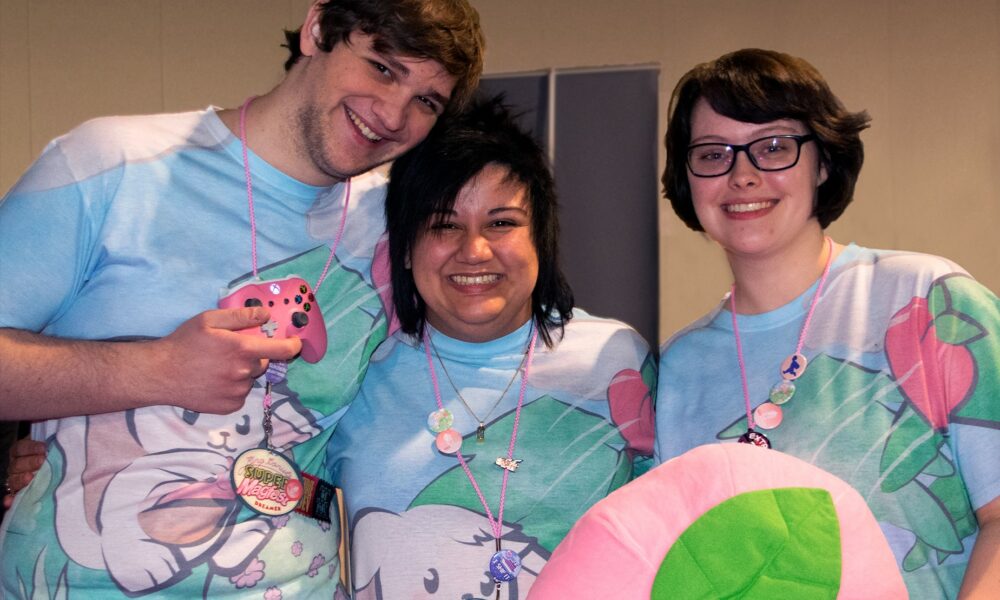
Today we’d like to introduce you to Boba Studios. Check out their story they shared with us below:
As a child, our co-founder, CEO, game designer, and writer, Ashley Guchhait, dreamed of building a game studio to tell her own stories and create the accompanying art. She was fortunate to realize this dream through her education at Maryland Institute College of Art (MICA). She eventually met her other co-founders, Kyrstin, our team’s Chief Creative Officer, artist, and animator, and TJ, our composer and sound designer. It started as a two-week project with Kyrstin: a 2D, color-matching, action game called Pocket Fox that could be beaten in less than five minutes. And while this little fox’s story was laid to rest with that project, its legacy of utilizing color theory as the core mechanic remained in the backs of our minds.
Two years later, we began our thesis project. Motivated by the goal of creating a project that encapsulated all of our majors, we decided on making a story-based game. This game eventually adopted an evolved color theory mechanic from our past work and a character design by a dear friend. With the emphasis on cute characters, color, and story, the next logical step for us was to design it after watercolor pop-up books, finalizing the foundation of Squirrely Roo Rabbit, Boba Studios’ soon-to-be debut game.
Within the year, we created four levels, participated in about a dozen exhibitions and conventions, posted a handful of free demos online for download, where we accumulated a 4.8/5 star rating, and participated in MICA’s creative venture competition, UP/Start, to win a grant to fund our studio. While it would take another year to win UP/Start, we were elated to be building our dream together and being recognized as legitimate game devs in such a competitive field. After all, no one ever says dream small for a reason!
Today, Boba Studios is a women-owned indie game studio based in Baltimore, Maryland, developing games to help represent underserved players, specifically women, and people of color, by providing the content players overlooked in the mass market are actively seeking created by a team that reflects them. After being in the industry for a few years and learning so much, being quarantined inspired us to rebuild Squirrely Roo Rabbit from the ground up to make it the game we have always imagined it could be! While COVID-19 did put a bit of a wrench in our showcasing plans (we were at 85 exhibits before the pandemic), staying home allowed us to focus on what truly mattered with the development, which was especially significant with Ashley taking over the role of our programmer. We are getting back into the world and are ecstatic to share our games again. After all, games are meant to be interactive, and we can not wait to meet you!
Let’s dig a little deeper into the story – has it been an easy path overall, and if not, what were the challenges you’ve had to overcome?
As a women-owned video game studio composed two-thirds of women but 100% of artists, we find ourselves at an odd intersection of art, tech, and business. Because, unfortunately, our culture believes women do not create tech, that tech is not an art, that art is not business, and that games do not make a good tech business. All of this is further compounded by our ages and skin colors. This seemingly unexpected overlap leads to trepidation, confusion, criticism, and, at worst, aggression. Because we consider ourselves interdisciplinary and women in various mediums and industries, this proves to be one of our most significant challenges. We apply to many exhibits, competitions, and conventions that include or feature any of some, if not all, of the aspects of art, tech, or business—not just video games, so having this push-back can be discouraging. We believe strongly, however, that there is a place for us and people who look like us, which we uphold through continuing to apply, attend, invite others into existing spaces, and creating spaces for others using our achievements—like co-chairing the International Game Developers Association, Washington, D.C. Chapter’s board—and sharing our experience to express to others how they are not alone in this. One of our most recent initiatives is writing a newsletter series breaking down these significant antagonism experiences, revealing we were not welcome in the space and how we dealt with it. This led to one of our proudest moments. A fellow female developer stopped us at an event celebrating women in games to share how much the newsletter helped her through some challenging experiences. Every dev at the event gathered around to open up with one another after, and we all greatly bonded and have been friends and supporters of one another since.
Can you tell our readers more about what you do and what you think sets you apart from others?
When scorned chameleons swap the colors of all other animals, causing mass confusion and upset, Squirrely Roo, a hybrid animal, springs into action with her chameleon-outcast friend, Cammie, to track down the chameleon king and return peace to the world. Powered by fruit, Squirrely Roo, and Cammie explore new lands and solve their puzzles! Squirrely Roo Rabbit is an in-development, 2.5D puzzle-adventure video game based on color theory and featuring a visual style reminiscent of watercolor pop-up storybooks.
Boba Studios has created ten games together as a team and 100+ games and prototypes collectively by our individual members. Outside of Squirrely Roo Rabbit, we have also made 2D and 3D video games, tabletop, card, VR, and hybrid games. Four of these games were created over 48 hours during the annual Global Game Jam. While due to the time constraints, they are all smaller projects, they all serve as wonderful springboards for future games!
The latest Squirrely Roo Rabbit demo is available now at www.bobastudios.com and being shown live across the East Coast this summer! Stay tuned for our next update coming this fall!
We all have a different way of looking at and defining success. How do you define success?
Defining success is difficult because of how personal it is. In fact, it goes so far in being specific that it often changes case-by-case with each project. For example, success for our Global Game Jam this year was a lot smaller in scope than it was in previous years as we were dealing with a difficult period of loss. For the first time since we started participating in 2017, success for the jam was just participating in it and creating something new, together. It was also just after we all moved back to Baltimore following the pandemic, marking the first time we had all lived closely in almost four years.
However, I think we can all agree that one of the most rewarding experiences we have shared for any game of any scope is when someone shares you have had an impact on them. Whether that is just remembering playing it years before and having fun, or something deeper like the experience that brought you together with someone or helped you during a tough time.
Pricing:
- Because Squirrely Roo Rabbit is still in development, the demo is available for free on our website. We aim to keep these updates in line with our stage in development, so be sure to check back regularly for something new! We also have Boba Studios merchandise available on our Etsy shop, which directly funds our development. All of these range from $1.50-37.
Contact Info:
- Email: play@bobastudios.com
- Website: https://bobastudios.itch.io/squirrely-roo-rabbit
- Instagram: https://www.instagram.com/bobastudios/
- Facebook: https://www.facebook.com/bobastudiosplay
- Twitter: https://twitter.com/bobastudios/
- Youtube: https://www.youtube.com/channel/UC9MVTqbHxxLNb-xYUG2PJ8A
- SoundCloud: https://soundcloud.com/user-172176952
- Other: https://squirrelyroo.us15.list-manage.com/subscribe/post?u=161fcbf120349c4f4df744a09&id=de352d822f#_=_


Image Credits
Ashley & Amadeus Guchhait