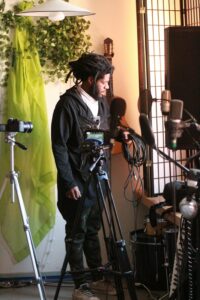
Today we’d like to introduce you to Kariz Marcel.
Hi Kariz, we’re thrilled to have a chance to learn your story today. So, before we get into specifics, maybe you can briefly walk us through how you got to where you are today?
I started as a child rapper. I used to get my mother to sign me up for talent shows around town. This was in Reston, Virginia, a small suburban town outside Washington DC. After winning a few talents shows I realize that I wanted to be more than just a rapper, I wanted to make the music that people rapped on. At nine years old I suffered from a tragic accident playing for the youth football league. I broke my left arm in three different sections and underwent several surgeries to save my arm. My love for playing sports ended abruptly and got swap out for my love to make music. That Christmas I asked my mother to give me a keyboard or a drum machine so I can start to make my own music, I was 10 years old by this time. I figured since I was in the house all the time I might as well do something creative. Eventually, my mother married a Morgan State University graduate and moved us away from Virginia to Baltimore Maryland. This was in the mid-90s when the hip hop scene was not fully evolved and respect was everything when he came to bars and lyrics. I met a young aspiring music producer from West Baltimore named Imani, he showed me how to make beats and how to record vocals. By the 10th grade, I was selling beats and studio time out of my basement while my mother was at work, this was when I realize that I can actually make money and make a living from this craft. After graduating high school, I attended the Institute of Audio Research Manhattan New York. While attending school I kind of lucked out and got an internship at a recording studio in Yonkers as well as signing my first production deal from a small Ruff Ryders affiliate company in East New York. By 19 years old I was making beats, assistant engineering, working as a videographer on a local hip hop TV show, and being a studio intern. I had the pleasure to work with some major recording artists and get an inside view of how the music industry works. By 20 I was moving back t9o Baltimore to put all my newfound information to work. I felt like it would be harder to take over New York as a music producer, so I decided to come back home to Bmore to start a production company with the same guy that taught me how to make beats. By 2002 I was fully active and producing for some of the biggest acts in the city.
I’m sure you wouldn’t say it’s been obstacle-free, but so far would you say the journey has been a fairly smooth road?
It definitely has not been a smooth road. The struggles were endless. I was practically homeless for the majority of my stay in New York City. I stayed in a barbershop owned by the CEO of the company that I was signed to, sleeping on the same futon that customers waited on to get their hair cut. For many years I sold beats in studio time to local rappers to pay my bills. I was fully committed to building a lifestyle around my talent. This put me in some very dangerous and sometimes awkward positions. I was always convinced that struggle was a part of the journey. I assume that as long as I was productive, making music, and doing the things I love that the struggle will not have a negative impact on my health. Boy was I wrong. I don’t regret those years but I often wish I had a mentor to help guide me in this journey. Many struggles were financial on top of that I couldn’t keep a girlfriend to save my life. Music was EVERYTHING!
Thanks – so what else should our readers know about Blakwater Production House?
My wife and I started Blakwater Production House in order to combine talents of visual and audio production. I eventually took a major leap and decided to move my studio to a space downtown. For about 10 years I ran Kariz Kids Youth Enrichment services. In this business, I wrote after school curriculum and hired instructors. My programs served thousands of youths during the time we were active. I eventually saw a need for adult enrichment and development programs. By securing a space it became easier to work with the artists’ community and start testing out some program ideas for the city. We decided to name the space The Blakwater House. This space is dedicated to multimedia curated events and programs as well as studio time content development. The goal is to have an exclusive membership-based model that targets both the working class and creatives throughout the DMV. We currently offer music production, creative events, and space rental.
We built this space to introduce people to our art and practices. The main thing that sets us apart is the vibe and spirit of the space as well as the well diverse group of people. We are not only based in entertainment but as well as education and professional development.
We are most proud of the fact that we are located in the Bromo Arts District. We shot the “Hey Baltimore” music video here. This song was featured in the “Dark City Beneath the Beat”, a Netflix documentary directed by TT The Artist and produced by Issa Rae. We are also responsible for some of the production behind Jidenna’s last album “85 to Africa” as well as the production of Shordie Shordie and Murda Beatz collab album entitled “Memory Lane”.
I want you readers to know that we are creating a very cool and creative space for the city to learn about the music scene and everything we have to offer the world on a creative and cultural level. They should follow us in IG @blakwaterhouse for updates and up-and-coming events and program registration opportunities.
Do you have any advice for those just starting out?
Nowadays it’s a little easier to get started because of the Internet and all of the resources that are available for free. My advice for anybody trying to be successful from their ideas is to never give up. As cliché as that sounds it is the truth. I grind it for 20 years until my talent reached a mainstream space. I would also advise aspiring artists to find a mission and purpose and to identify the reasons they want to be successful in music. When the money is coming in and the fans are buying music you have to have something that keeps you going and it’s something usually has a lot to do with love, passion, willpower, and the desire for the world to know who you are. Seek mentorship often and be original!
Contact Info:
- Email: kariz@blakwatermusic.com
- Website: www.blakwaterhouse.com
- Instagram: https://www.instagram.com/karizmarcel/
- Youtube: https://www.youtube.com/user/karizmarcel
- SoundCloud: https://soundcloud.com/karizmarcel


Image Credits
Roy Cox
Timothy Christmas
Sarah Foda
US Cuba Artist Exchange Program
Shae McCoy
Retji Dakum
December Moon
Alexia Webster